
Launching Kentucky’s
First UX Degree
A UX Case Study in Designing an Academic Program
Project Overview
Launching a new undergraduate major might look like an administrative task—but it’s actually a complex UX design problem.
In this project, I helped launch Kentucky’s first Bachelor of Science in User Experience (UXBS)—the first undergraduate degree of its kind in the state. I approached the academic program itself as the product, prospective students as primary users, and institutional policies as real-world constraints.
This case study documents how UX methods can be applied beyond screens—to systems, curricula, and organizational structures.
Why this matters: While demand for UX professionals continues to grow, higher education has been slow to develop undergraduate pathways into the field. Fewer than 150 UX-related programs exist globally, and only about 20 are four-year undergraduate degrees in the U.S. at the time of launch.
This gap between industry need and educational infrastructure was also the foundation of my ACM publication: Piloting a Replicable Model for Undergraduate User Experience Education: An Interdisciplinary, Capacity-Building Framework. (Full publication coming soon!)
My Role: Program Coordinator
Date: Fall 2023 – Fall 2025
The Challenge
UX is a field that many prospective students (and their families) have never heard of—or misunderstand as purely visual design. At the same time, universities are highly structured systems with rigid policies, legacy curricula, and siloed departments. UX, by contrast, is inherently interdisciplinary.
The core challenge:
How might we design a new academic major that is understandable, desirable, and navigable for students—while remaining viable within institutional constraints?
This required balancing:
- Student expectations and mental models
- Industry-aligned UX competencies
- STEM designation requirements
- Cross-college collaboration (Department of Art & Design in the Potter College of Arts & Letters, and the School of Engineering and Applied Sciences in the Ogden College of Science & Engineering)
Users & Stakeholders
Primary Users
- Prospective undergraduate students exploring majors
- Current students considering a major change
Secondary Users
- Parents and families seeking career clarity
- Academic advisors
- Faculty collaborators
Key Stakeholders
- University administration
- Overseeing council on Kentucky higher education
- Partner departments & colleges (Computer Science, SEAS, Ogden College)
Research & Discovery
Rather than traditional user research alone, this project relied on situated, longitudinal research embedded in teaching and advising contexts.
Methods included:
- Advising conversations with current and prospective students
- Classroom observation of how students encounter UX concepts for the first time (eg, Intro to UX Design, UX 220)
- Competitive analysis of peer UX, HCI, and design programs nationally
- Industry reports on regional and national workforce needs
- Formal survey distributed to Art & Design and Computer Science students
Takeaways from the survey included:
- 84% expressed interest in pursuing the UXBS
- 58% interested in adding the UXBS as a second degree
- 62% of respondents said they would have chosen the UXBS if it had been available
- The two most appealing factors:
- Combined CS + UX courses (68%)
- Total credit hours (53%) — this one is best understood in comparison to the existing BFA UX degree, which is about a third more credit hours
Reasons students gave for adding the major included:
- “It combines the thoughts and practice of computer science [with] the arts to be more creative, ultimately allowing for more fulfilling career.”
- “I enjoy front-end development and would love to be more qualified in design.”
- “I would like to take more classes in User Experience and I think adding a Bachelors of Science in would get more people outside of FAC (the Fine Art Center) interested in the degree.”
- “This seems like a blended program that would offer me the most well-rounded coursework and still give me a Bachelor of Science.”
Findings:
- Industry needs professionals who can bridge technical feasibility and user-centered design
- Double majoring was highly attractive across CS and Art & Design students
- Faculty collaboration was already happening organically, most notably in WKU’s Extended Reality (XR) Lab
- The demand existed, the infrastructure and precedent did not
Outcomes & Impact
- Established a clear, shared UX identity across the institution—now recognized and promoted by leadership
- Formalized existing cross-college collaboration, with implications beyond this single major
- Created a common language for UX across colleges/departments
- Positioned the program as both design-driven and STEM-aligned
Reflections
Designing this major reinforced that UX is not confined to products or interfaces. Policies, curricula, and organizational structures all shape user experience. Higher education is a complex, siloed system—one that could benefit deeply from UX thinking.
This project sharpened my practice in:
- Designing within complex institutional constraints
- Translating abstract fields into legible, user-centered experiences
- Advocate for users within bureaucratic systems
- Applying UX thinking at a systemic scale
More broadly, this work continues to shape my research agenda. I’m currently pursuing funding and scholarship focused on how universities can expand UX education to better align with workforce needs—while leveraging UX’s interdisciplinary nature to break down organizational silos.
Universities can expand UX offerings to better align with workforce needs and leverage UX’s inherently interdisciplinary nature to foster organizational collaboration that bridges existing disciplinary silos.
Launching a new major is slow, messy, and deeply human work. That’s exactly what made it one of the most meaningful UX problems I’ve designed.
Related Work
A New UX, for a New UX (Program)
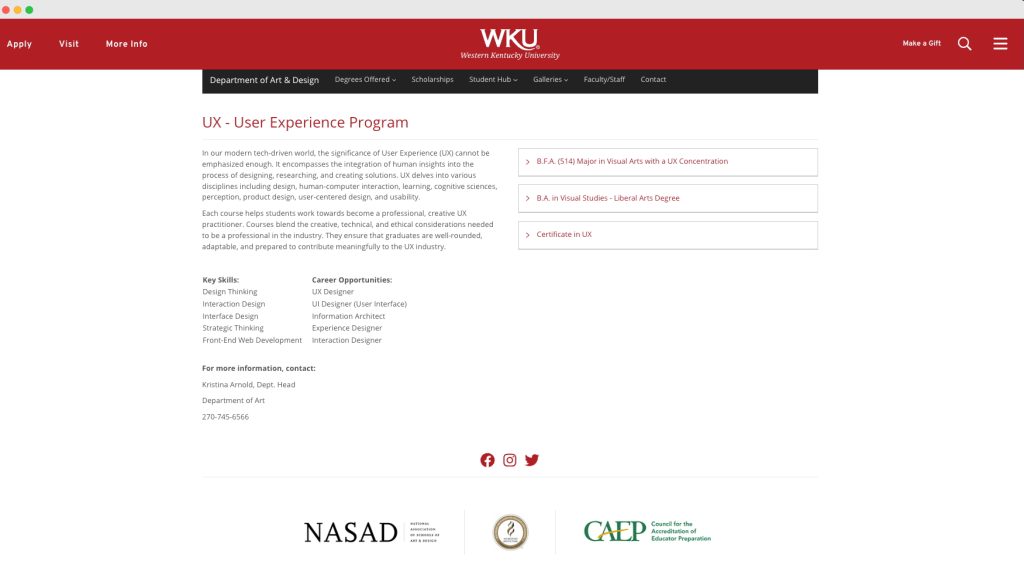
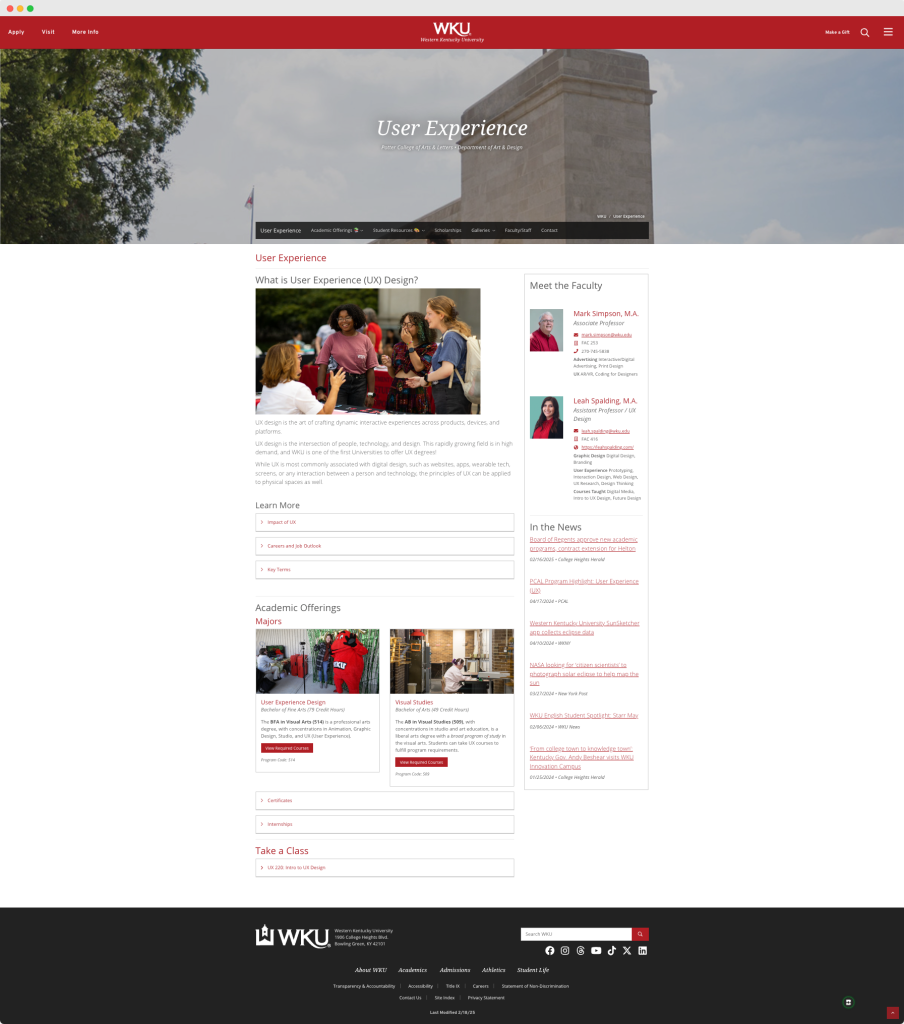
The homepage for Western Kentucky University’s (WKU) UX offerings serves as the digital front door for students, faculty, and industry professionals seeking information about the programs.
However, the previous webpage had zero imagery, let alone faculty, news, and advising resources. This redesign aimed to enhance usability, accessibility, and visual appeal while ensuring the site aligns with modern web design practices and follows WKU’s style guide. The site is geared towards the users: prospective and current UX students.
This webpage is built using Modern Campus CMS. There’s still a lot of work to do!
Before
After
Telling Students
Figuring out how to communicate the news to students was daunting, but if there’s one thing I know from UX, it’s to speak your users’ language.
Bear in mind that this was the effort of a scrappy team of one (me), whose main job is not social media, with a budget of $0.
And if there is one thing Western students love, it’s Topper Fella.
Topper Fella is part social experience, scavenger hunt, and collectible. It’s an absurd, 3D-printed figurine hidden around the nooks and crannies of campus, and the creator remains anonymous.
To know Topper Fella is to love Topper Fella.
Topper Fella was (willingly and lovingly) exploited on the Department of Art & Design’s Instagram, our student-facing social platform.
Results
The results? The posts earned views well beyond our average: over 100% higher than our typical posts. We also engaged with people who weren’t already following us. I also formed a relationship with TopperFella, which resulted in the design of a custom Art&Design CommunityFella the following semester.
As they say, the best social media strategy is often the most unhinged. At least, if your target audience is college students.